AI Eats the Obvious
Why ambition moves to constraints customers cannot name yet

Silicon Valley’s best startup advice is still the simplest: make something people want.
Paul Graham wrote that Y Combinator came up with the phrase about a month after YC started, and that if he were choosing again, he would still pick the same motto [1]. He was right. It is the perfect antidote to founder delusion: building something impressive that nobody needs.
But the advice needs an update.
For a long time, knowing what people wanted was a serious advantage because building software was still hard. If you understood a customer pain point and could ship a good product against it, that alone could be a company.
AI changes the cost curve.
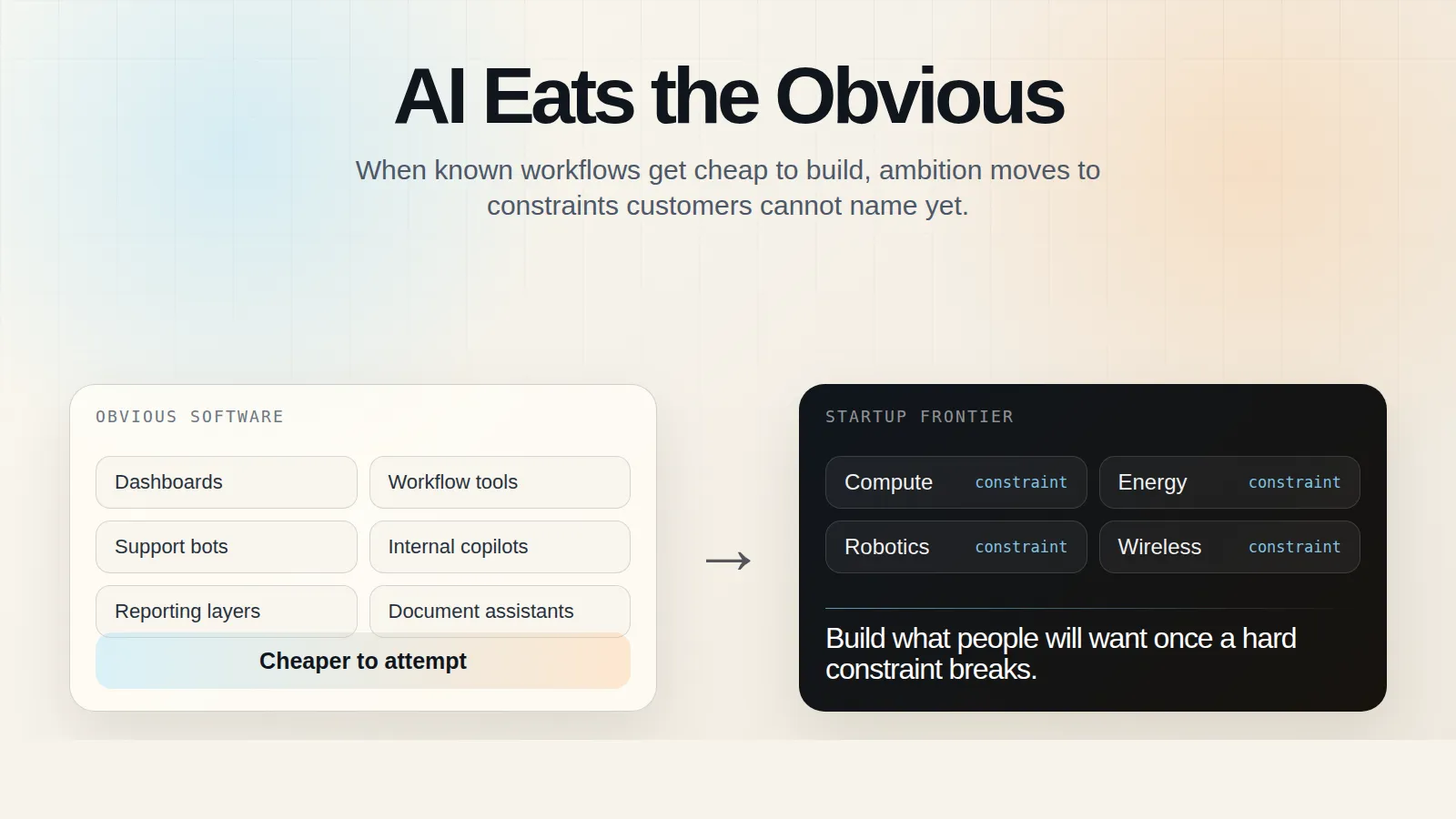
If a customer can already describe the product clearly, whether it is a dashboard, a workflow tool, an internal copilot, a reporting layer, a support bot, or a document assistant, the first version is now cheaper to build than ever.
Not free. Not trivial. Enterprise trust, integrations, regulation, security, distribution, and reliability still matter. But the act of turning a known workflow into usable software has been compressed.
You can already see it in how software gets built. Stack Overflow’s 2025 Developer Survey found that 84% of respondents were using or planning to use AI tools in their development process, and 51% of professional developers used them daily [2]. Not because AI writes perfect products. Because obvious software is becoming cheaper to attempt.
The next great startup advice cannot stop at: make something people already want.
The more ambitious version is: make something people will want once a hard constraint breaks.
The market cannot ask for the breakthrough
Section titled “The market cannot ask for the breakthrough”Customers are often very good at describing pain. They are much worse at specifying the breakthrough.
They can ask for brighter lamps. They cannot ask for dynamos, switches, meters, transmission lines, and an electrical grid.
They can ask for faster communication. They cannot ask for radio.
They can ask for better surgery, faster checkout, cheaper bandwidth, and precision manufacturing. They cannot ask for the laser before coherent light exists.
This is why “solution looking for a problem” is not always an insult.
The first working laser was reported in 1960 and was described that way. The laser’s strange new capability was an intense, narrow beam of light at a single wavelength. It later became useful across science, medicine, supermarket checkout, and communications [3].
Hertz produced and detected radio waves, but reportedly did not think they would have practical application. Wireless communication became one of the defining technologies of the modern world [4].
Faraday’s electromagnetic induction was not a customer-requested feature. It was a physical discovery. Within months, he had built a primitive electric generator [5].
In each case, the capability came before the market could name the product.
That is the pattern worth paying attention to.
Of course, most “solutions looking for problems” really are bad ideas. Technical difficulty is not the same thing as importance. A science project does not become a company just because it is hard.
The good ones have a theory of timing. They are early to a bottleneck, not detached from reality.
They say: this constraint will become painful, the current architecture will not scale, and if we break it, new demand will appear.
Cerebras as a timing bet
Section titled “Cerebras as a timing bet”Cerebras is a modern version of that bet.
The company was founded in 2015 to bring wafer-scale computing to market. Cerebras says that, at the time, it was unclear whether such a thing was technically possible [6]. That is not the usual shape of a customer-discovery startup. In 2015, the market was not broadly asking for wafer-scale AI processors. Most customers did not yet understand the bottleneck.
But the bottleneck was coming.
As AI models grew, compute became one of the central constraints of the technology industry. Latency, inference cost, memory bandwidth, power, and chip supply became strategic problems. Reuters described Cerebras as making specialized chips for advanced AI models in a market dominated by Nvidia, and noted that demand for its processors had surged as AI labs shifted from training models to deploying them [7].
Cerebras has not “won” because it went public. Public markets can be wrong, especially around AI. Nvidia is a brutal competitor. Hardware is hard. Scaling is hard.
But the IPO proves something narrower and more interesting: a technical bet that looked early and strange in 2015 became legible once the market felt the constraint. Cerebras closed its IPO in May 2026, selling 34.5 million shares at $185 per share and raising about $6.38 billion in gross proceeds [8].
The constraint comes first
Section titled “The constraint comes first”I am biased here. At Ixana, we spend a lot of time thinking about wireless constraints customers do not describe in technical language. They do not ask for a new physical layer. They ask why devices cannot be smaller, last longer, transmit with less power, or work in form factors today’s radios make impossible.
The constraint comes first.
The product category follows.
One way to separate vision from fantasy is to ask what the company is early to. A market bet is early to demand: customers already want something, and the startup delivers it better. A technical bet is early to a constraint: the market has learned to work around a bottleneck, and the startup believes that if the bottleneck breaks, new demand will appear.
AI will create plenty of good market-bet companies. Some will become valuable.
But if AI keeps making the obvious cheaper, the most important companies of the next decade are more likely to come from technical bets: compute, energy, robotics, biology, materials, security, interfaces, wireless, and infrastructure.
There is also a less abstract version of this argument: the countries that own the next physical layer will not be the ones that spent the decade building better dashboards.
That is how frontier companies usually begin: with a bottleneck the market has learned to live with.
“Make something people want” is still good advice. But if AI eats the obvious, the frontier has moved.
Make something people will want.
References
Section titled “References”[1] Paul Graham, “Be Good,” April 2008 https://paulgraham.com/good.html
[2] Stack Overflow, “2025 Developer Survey: AI” https://survey.stackoverflow.co/2025/ai
[3] Charles H. Townes, “The First Laser,” University of Chicago Press https://press.uchicago.edu/Misc/Chicago/284158_townes.html
[4] Institute of Physics, “Hertz’s Useless Discovery” https://spark.iop.org/hertzs-useless-discovery
[5] Encyclopaedia Britannica, “Faraday’s Discovery of Electric Induction” https://www.britannica.com/science/electromagnetism/Faradays-discovery-of-electric-induction
[6] Cerebras, “Company” https://www.cerebras.ai/company
[7] Reuters, “Cerebras Prices IPO at $185 per Share to Raise $5.55 Billion,” May 13, 2026 https://www.reuters.com/legal/government/cerebras-prices-ipo-185-per-share-raise-555-billion-sources-say-2026-05-13/
[8] Cerebras, “Cerebras Systems Announces Closing of Initial Public Offering,” May 15, 2026 https://www.cerebras.ai/press-release/cerebras-systems-announces-closing-of-initial-public-offering