Agents Are Eating the Org Chart
Why the next scarce resource inside companies is not output, but accountable coordination
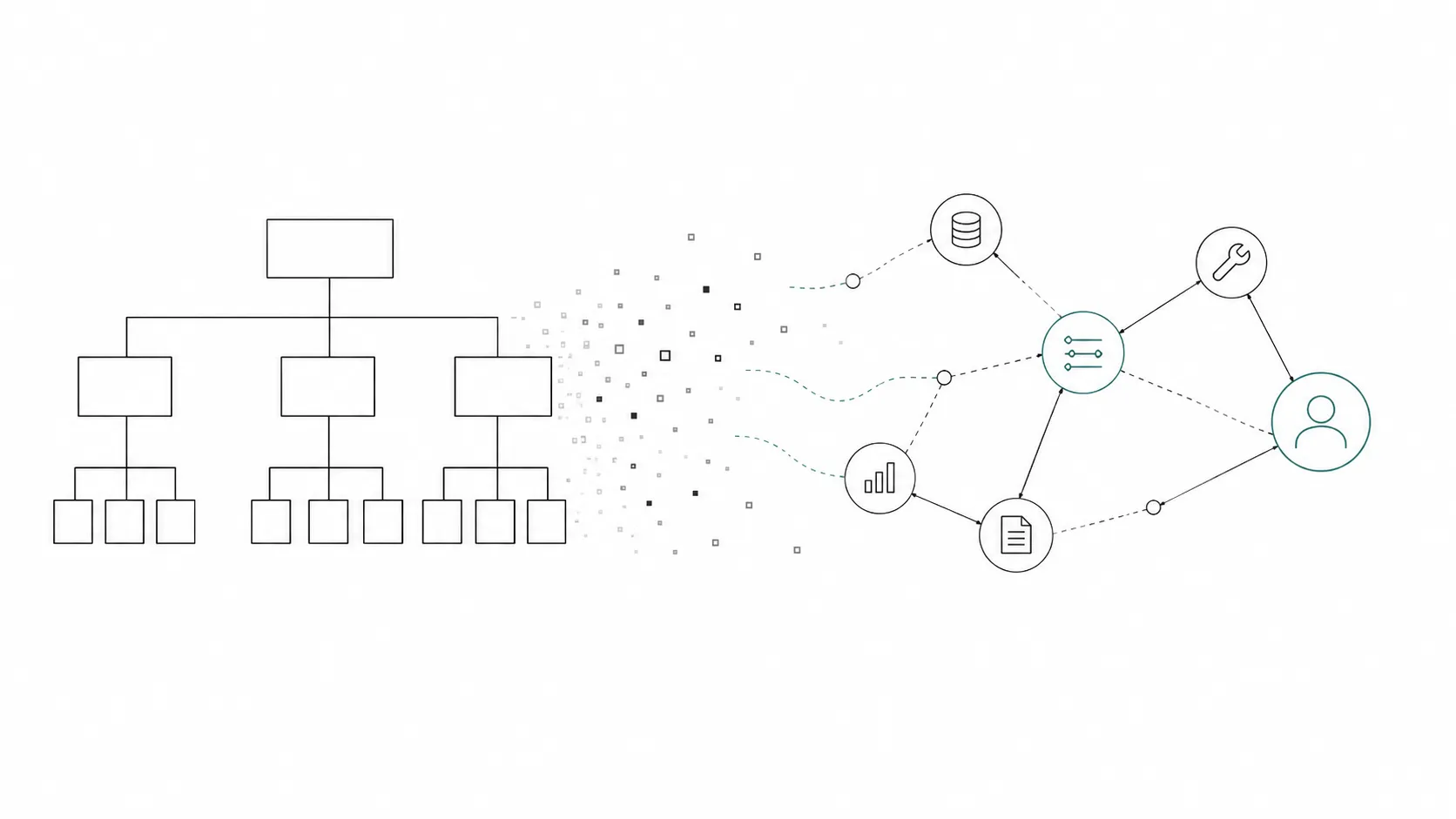
AI is not just making workers faster. It is lowering the cost of coordination, exposing the roles, handoffs, software, and management layers that existed because execution used to be expensive.
The argument
Section titled “The argument”AI is not only lowering the cost of producing artifacts. It is lowering the cost of moving work between people, tools, systems, and decisions.
A lot of the modern org chart exists because context was expensive to move. People translated intent into notes, notes into tickets, tickets into dashboards, dashboards into meetings, meetings into slides, and slides back into decisions.
Agents compress that “work between the work.” They do not remove judgment. They make judgment more important because bad assumptions can now move faster through the company.
Which parts of this org chart only exist because execution used to be expensive?
Does this company redesign work, or merely add AI to old workflows?
The founder question is no longer just “how do we use AI?” It is “which parts of this org chart only exist because execution used to be expensive?”
The investor question is no longer just “does this company have AI?” It is “does this company redesign work, or merely add AI to old workflows?”
The winners will not be the companies with the most AI pilots. They will be the companies that redesign work around intent, execution, verification, and accountable decisions.
The work between the work
Section titled “The work between the work”In 2011, Marc Andreessen wrote that software was eating the world [1].
The line lasted because it was not really about software. It was about cost. Once a business process could be expressed in code, it could be copied, scaled, measured, improved, and distributed at near-zero marginal cost. A bookstore became software with warehouses attached. A media company became files, feeds, recommendations, payments, and licensing. A bank became ledgers, risk models, APIs, compliance systems, and a charter.
The old company did not disappear. It got wrapped in software. Now the next layer is being rewritten. Not just the product. Not just the database. The workflow. The boundaries between roles. The org chart.
Walk through a normal company and ignore the mission statement. Watch the actual work.
A customer says something on a call. Someone turns the call into notes. Someone turns the notes into a ticket. Someone checks the dashboard. Someone asks data whether the dashboard is right. Data asks product which metric definition leadership wants this quarter. Product asks engineering whether the issue is on the roadmap. Engineering asks support how often customers complain. Support exports Zendesk. Someone makes a spreadsheet. Someone turns the spreadsheet into three bullets. Someone turns the bullets into a slide.
This is not a broken company. This is a normal company.
A surprising amount of white-collar work is neither strategy nor craft. It is translation. Intent becomes notes. Notes become tickets. Tickets become status. Status becomes slides. Slides become decisions. Decisions become new tickets. The bottleneck is often not doing the work. It is moving context from one system, team, meeting, or artifact into the next.
Agents close part of that gap. By agent, I do not mean a chatbot with a friendlier name. I mean a model connected to context, tools, data, permissions, memory, and workflow. An agent can receive a goal, inspect context, call tools, retrieve data, generate an artifact, revise it, pass work into another system, and report back. It will still fail. Sometimes quietly. Sometimes with impressive confidence. But the important shift is continuity: some work can keep moving when a human is not touching the keyboard.
I have started to notice this in my own work too. The handoff changes when a rough idea can arrive with a first-pass artifact, assumptions, and failure modes already attached. Instead of asking someone to explore every idea from zero, I can use agents to do the messy first pass, then bring the relevant lead something sharper to inspect. The expert still matters. In fact, the expert matters more. But the early coordination loop gets compressed.
That changes the shape of the firm.
The public signals are already here
Section titled “The public signals are already here”The best early example is not a chatbot. It is Walmart’s product catalog.
On its Q2 FY2025 earnings call, Walmart said it had used multiple large language models to create or improve more than 850 million pieces of product catalog data. The company said doing the same work without generative AI would have required nearly 100 times the current headcount to finish in the same amount of time [2].
That sounds clerical. It is not. In retail, catalog data is infrastructure. It determines whether a customer finds the right item, whether search works, whether a warehouse knows what to pick, whether a substitute makes sense, whether an associate can identify packaging quickly, whether inventory is routed correctly, and whether delivery works. Bad catalog data is a business problem hiding in metadata.
Walmart shows the operating layer. Shopify shows the management layer.
In 2025, Shopify CEO Tobi Lütke told employees that before asking for more headcount or resources, teams had to show why they could not get the work done using AI. He also asked what an area would look like if autonomous AI agents were already part of the team [3].
That reverses the default. The old answer to overload was to add people: analysts, coordinators, program managers, junior engineers, operations staff, or someone to chase status and keep the process alive. Shopify’s question is different: why does this work require another human?
Coinbase made the org-chart question explicit. In May 2026, Coinbase announced it would reduce the size of the company by about 14 percent. Reuters reported that the cut would affect about 700 jobs as Coinbase adjusted costs amid crypto-market volatility and repositioned the business for the AI era [4], [5].
The layoff number is not the main point. Layoffs are blunt, and Coinbase cited both market cyclicality and AI-driven changes in how work gets done. The stronger signal is the operating model. Brian Armstrong wrote that engineers were using AI to ship in days what previously took teams weeks, that non-technical teams were shipping production code, and that many workflows were being automated. Then he moved from productivity to structure: flattening to a maximum of five layers below the CEO and COO, eliminating pure managers, expecting player-coach leaders, concentrating around AI-native talent that can manage fleets of agents, and experimenting with smaller pods, including one-person teams [4].
That is not a tooling update. It is an org-design update.
Coinbase is effectively saying that when execution can be done with fewer people and more machine leverage, management layers have to justify themselves differently. A layer that once coordinated scarce human execution can become overhead when context assembly, drafting, analysis, code generation, and workflow movement get cheaper.
The phrase that matters most in Armstrong’s memo is “coordination tax” [4].
That is the tax agents are starting to attack.
What is actually being eaten
Section titled “What is actually being eaten”The first internet wave ate distribution. Cloud ate infrastructure. SaaS ate departmental workflows. Agents are eating coordination.
Coordination is the hidden tax inside the modern firm. It is the cost of making sure the right context reaches the right person, in the right format, at the right time, so the next step can happen. Companies often call this management. Sometimes it is. Often it is glue.
Glue work is everywhere. Sales updates the CRM after a call. Customer success re-explains the same account history to support. Finance asks product for a forecast. Product asks engineering for a timeline. Engineering asks data for a metric. Data asks which metric definition is currently accepted. Then someone writes a doc explaining why the numbers do not match.
None of this is the customer’s problem, but the customer pays for it.
The org chart is partly a map of expertise. It is also a map of friction. Every handoff that software could not understand became a role, a queue, a meeting, a manager, a dashboard, or a process. Agents do not eliminate the need for humans. They eliminate some of the reasons humans have to wait for each other.
That is less theatrical than “AI replaces workers.” It is also more consequential.
The frontier is jagged
Section titled “The frontier is jagged”The optimistic story says AI makes everyone faster. The evidence is already more interesting than that.
METR ran a randomized controlled trial with experienced open-source developers working on their own repositories. Developers using early-2025 AI tools took 19 percent longer than developers working without them. More strikingly, developers expected AI to speed them up before the work, and after experiencing the slowdown, still believed AI had helped them move faster [6].
That result should make every executive nervous. AI can create the feeling of acceleration while slowing the system down.
The jagged-frontier study of BCG consultants points in the same direction. In a preregistered experiment with 758 knowledge workers, consultants using AI completed 12.2 percent more tasks and worked 25.1 percent faster on 18 tasks inside the AI capability frontier. On a complex managerial task outside the frontier, consultants using AI were 19 percentage points less likely to produce correct solutions [7].
This is the world we actually live in. AI works unevenly. It is spectacular in one lane, mediocre in another, harmful in a third, and changing quickly enough that last quarter’s map is already stale. It can make weak work look polished. It can move a bad assumption through five systems before anyone realizes the first step was wrong.
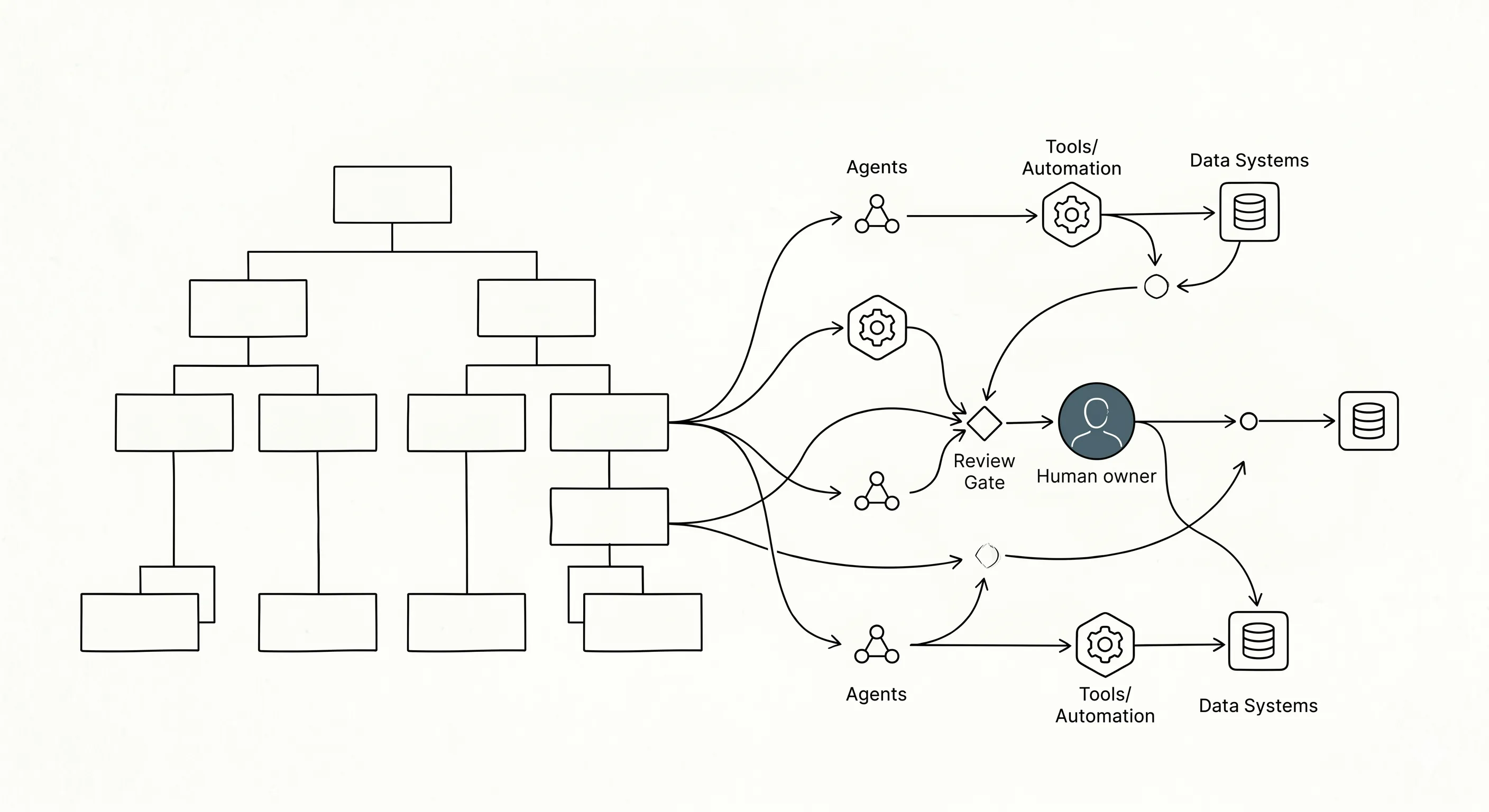
This is why the org chart matters. The question is not only which tasks can be accelerated. The question is where acceleration becomes dangerous. Where should the machine run? Where should it be watched? Where should it stop? Where should a human remain accountable for the commitment?
Without that architecture, AI does not make the company smarter. It makes the company faster at spreading its own mistakes.
Fast exploration, hard commitment
Section titled “Fast exploration, hard commitment”Some work should become much faster.
In RF and sub-THz circuit design, deep-learning inverse design has shown that complex design workflows can move toward minute-scale synthesis and open design spaces that traditional template-driven approaches had difficulty reaching [8].
That is not just a productivity feature. It is a change in tempo.
When exploration gets cheaper, the rational response is to explore more: more variants, more simulations, more customer segments, more failure-mode analysis, more market tests, more pricing scenarios, more drafts before the final draft. But commitment should not get cheaper at the same rate.
Hardware makes this easiest to see. A chip tapeout is a useful stress test because the physical world does not care how polished the generated document looked. Agents can help draft review checklists, summarize simulation outputs, search constraints, compare variants, generate documentation, and keep work moving across multiple threads. You do not delegate signoff.
The important question is not whether an agent can draft something plausible. It can. The question is which parts of the workflow can be accelerated without corrupting the artifact that eventually becomes silicon.
The same distinction applies beyond semiconductors. Drug discovery can explore faster, but clinical judgment still matters. Finance can model faster, but risk ownership still matters. Legal work can draft faster, but liability still lands somewhere. Customer support can answer faster, but the wrong answer to the wrong customer still becomes a real business problem.
The future is faster exploration and harder commitment.
The exposed work
Section titled “The exposed work”Every major platform shift exposes the jobs protected by the old cost structure. This one will be harsh because the old cost structure is everywhere.
The most exposed work is not necessarily low-status work. It is work whose value depends on information being hard to move, summarize, translate, or reformat: status collection, meeting summarization, spreadsheet maintenance, generic first drafts, ticket grooming, dashboard reconciliation, and alignment work without decision ownership. This does not mean the people doing that work are useless. It means the job design is weak.
The same is true for managers. A manager who only asks for updates is in trouble. A manager who turns ambiguity into priorities, catches bad assumptions, makes tradeoffs, and owns the outcome is not. Middle management will not vanish, but bad middle management will be harder to hide.
The first mistake companies will make is treating AI adoption as a participation metric. How many employees are using it? How many prompts were run? How many drafts were generated? How many bots were launched?
Those numbers are easy to collect and easy to celebrate. They measure activity, not operating improvement. A company can generate more summaries, dashboards, prototypes, outbound emails, tickets, and internal documents while becoming no better at deciding what matters.
More output without judgment is inventory.
The new moat
Section titled “The new moat”Access to models will not be a moat for most companies. Models will improve, commoditize, and get bundled into office suites, CRMs, developer tools, cloud platforms, support systems, and phones. The advantage will not come from saying “agent” in a press release.
The advantage will be operating architecture: the ability to make intent explicit, assemble context early, remove handoffs without removing accountability, distinguish exploration from commitment, and verify machine-produced work before it becomes the input to more work.
The hardest part is ownership. When humans, agents, tools, and datasets all touch a decision, the organization still has to know who owns the outcome. The agent did not decide. The workflow did not decide. The dashboard did not decide. Someone owns the outcome.
In strong companies, agents will compress cycle times and expand the surface area of serious people. In weak companies, agents will generate activity that looks like progress until someone asks who owns the decision.
This is how AI makes a company faster and more fragile at the same time.
The real divide
Section titled “The real divide”The divide will not be between companies that use AI and companies that do not. That divide will close.
The real divide will be between companies that bolt AI onto the org chart and companies that redesign the org chart around AI.
The first group will measure adoption. The second will redesign work.
Software ate the world by turning business processes into code. Agents will eat the org chart by turning coordination work into governed execution.
The winners will not be the companies with the most AI pilots. They will be the companies that can run more of the business through a tighter relationship between intent, execution, verification, and decision.
Execution is getting cheaper.
Owning the outcome is not.
Related
Section titled “Related”This essay is the company-level companion to The Multi-Threaded Operator. If agents change the structure of the company, the next question is what kind of person becomes more valuable inside it. I call that person the Multi-Threaded Operator.
References
Section titled “References”[1] Why Software Is Eating the World https://a16z.com/why-software-is-eating-the-world/
[2] Walmart Inc. Q2 FY25 Earnings Call Transcript https://corporate.walmart.com/content/dam/corporate/documents/newsroom/2024/08/15/walmart-releases-q2-fy25-earnings/corrected-walmart-inc-wmt-us-q2-2025-earnings-call-15-august-2024.pdf
[3] Shopify CEO tells teams to consider using AI before growing headcount https://techcrunch.com/2025/04/07/shopify-ceo-tells-teams-to-consider-using-ai-before-growing-headcount/
[4] Building a leaner and faster Coinbase https://www.coinbase.com/blog/building-a-leaner-and-faster-coinbase
[5] Crypto exchange Coinbase to cut about 14% of workforce in AI-driven restructuring https://www.reuters.com/business/world-at-work/coinbase-cut-about-14-workforce-2026-05-05/
[6] Measuring the Impact of Early-2025 AI on Experienced Open-Source Developer Productivity https://metr.org/blog/2025-07-10-early-2025-ai-experienced-os-dev-study/
[7] Navigating the Jagged Technological Frontier: Field Experimental Evidence of the Effects of Artificial Intelligence on Knowledge Worker Productivity and Quality https://pubsonline.informs.org/doi/10.1287/orsc.2025.21838
[8] Deep-learning enabled generalized inverse design of multi-port radio-frequency and sub-terahertz passives and integrated circuits https://www.nature.com/articles/s41467-024-54178-1