Before Outputs Become Inputs
The verification gate for agentic work
Most teams still think about AI risk as an output problem.
The model hallucinated. The summary missed something. The code did not compile. The answer was wrong.
Those failures matter, but they are usually not the scariest ones. Obvious errors tend to get caught. Broken code fails. A strange paragraph gets rewritten. A fake citation, if someone is paying attention, gets checked.
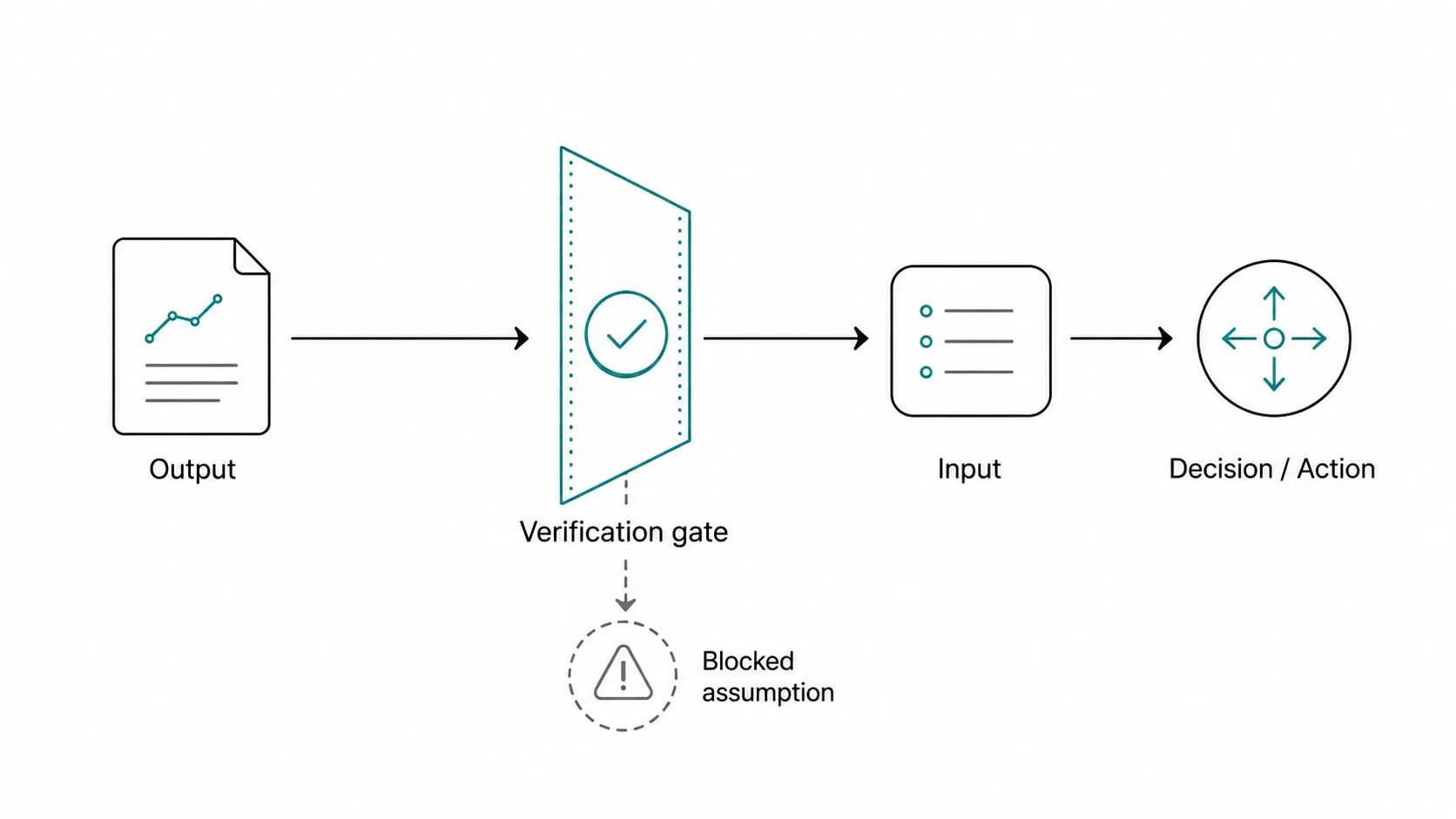
The more dangerous failure is quieter: a plausible output becomes an input.
A weak assumption becomes a spreadsheet. The spreadsheet becomes a memo. The memo becomes a recommendation. The recommendation becomes a meeting. The meeting becomes a decision. By the time someone asks where the original assumption came from, the organization has already built on top of it.
That is the failure mode this essay is about.
Not bad output.
Contaminated workflow.
The verification gate is the point where the operator stops the chain and asks:
Is this output allowed to become a premise?
Contamination, not hallucination
Section titled “Contamination, not hallucination”Imagine an agent summarizes recent customer calls and concludes that pricing is the main objection.
That sounds useful. Product starts exploring packaging changes. Marketing drafts new positioning. Finance models lower ACV. Leadership starts discussing discount strategy.
Only later does someone ask: which customers were in the sample?
Maybe the summary was based on three enterprise calls and ignored fifty support tickets. Maybe it over-weighted one loud customer. Maybe it confused procurement friction with willingness to pay. Maybe the real issue was implementation risk, not price.
The agent did not hallucinate in the cartoon sense. It produced a fluent synthesis from a bad frame.
That is why “hallucination” is too small a word for the operational problem. The output may be locally reasonable and globally dangerous. It may be well-written, coherent, and useful-looking. The issue is that it entered the workflow before anyone checked whether it deserved authority.
Once that happens, the organization starts laundering assumption into fact.
A gate is not a meeting
Section titled “A gate is not a meeting”A verification gate should not become a standing meeting, a compliance ritual, or another place where work goes to die. If it feels like bureaucracy, people will route around it. They will keep moving quickly and invent language that makes the process look compliant.
A gate is simpler than that.
It is the moment before an output becomes an input.
Before a generated analysis feeds a strategy memo. Before a memo becomes a recommendation. Before a recommendation becomes a roadmap. Before a review doc becomes signoff. Before a draft goes to a customer. Before code gets merged. Before a claim enters a board deck.
At that moment, the operator asks a small set of questions:
What is this claiming?
What is it based on?
What has to be true?
What would make it wrong?
Who checked it?
What is its current status?
Who owns the decision?
That is enough for most work. The gate does not need ceremony. It needs a human owner willing to slow the transition from output to premise.
Three gates, three trust levels
Section titled “Three gates, three trust levels”I find it useful to separate verification into three gates: source, assumption, and commitment.
Generated output does not outrank the system of record.
Fluent prose can hide the premise carrying the conclusion.
The standard rises when information turns into obligation.
The source gate asks whether the output used the right information. An agent can summarize stale documentation, pull from a dashboard with the wrong metric definition, reason from an outdated repository, or synthesize customer feedback without seeing the most recent tickets. The output may sound reasonable, but it is not grounded in the source of truth.
The rule is simple: do not let a generated output outrank the system of record.
If the source is wrong, fix the source. If the agent did not use the source, do not trust the output.
The assumption gate asks what has to be true for the conclusion to hold. Agents are very good at burying assumptions inside fluent prose. A feature is “high priority” if the sample is representative. A migration is “low risk” if dependencies are isolated. A market is “attractive” if the TAM is reachable through the company’s actual go-to-market motion. A design candidate “performs best” if the simulated environment matches the real one.
The operator’s question is not “does this sound right?”
The better question is: “right under what conditions?”
The commitment gate asks whether the output is allowed to become real. This is the gate that deserves the most pressure because it is where information turns into obligation. A customer can rely on it. A team can build against it. Finance can plan around it. A board can repeat it. A design can freeze around it.
At this point, the question is no longer “is this useful?” It is “are we willing to own the consequences if this is wrong?”
The gate standard should rise as the work gets closer to reality.
Interesting but ungrounded. Use the source gate.
Coherent but assumption-heavy. Use source and assumption gates.
Plausible but not safe to act on. Use source, assumption, and commitment gates.
Most mistakes happen when these modes blur. A brainstorm becomes a plan. A draft becomes a recommendation. A recommendation becomes consensus. Consensus becomes “what we decided.”
No one explicitly chose the transition. The work just kept moving.
That is commitment drift.
Do not gate everything
Section titled “Do not gate everything”The fastest way to ruin this idea is to apply it everywhere.
Not every generated output deserves a gate. A naming brainstorm does not need a review process. A rough list of objections does not need signoff. A first-pass search query should stay loose. Most exploration should feel cheap, fast, and reversible.
The gate matters when an output is about to become a premise for other work.
Will another workflow rely on this? Will a team act on it? Will a customer see it? Will money, roadmap, architecture, hiring, legal exposure, or reputation move because of it?
The point is not to slow down agentic work. The point is to slow down the moment where agentic work becomes organizational belief.
The RF example
Section titled “The RF example”Hardware makes this easy to see because the cost of being wrong becomes physical.
Imagine an agent reviewing candidate RF blocks before a design review. It ranks one candidate first because the simulated response looks clean. The plot is persuasive. The summary says the candidate meets target performance.
A weak workflow turns that into a recommendation.
A stronger workflow gates it.
Did the simulation use the actual target impedance environment?
Were package parasitics included?
Were the relevant process corners swept?
Were layout coupling effects modeled?
Did the test setup match the system this block will actually live inside?
The candidate may have looked best because the simulation assumed ideal source and load conditions. In the actual system, the environment is messier. The clean response was not evidence of real performance. It was evidence of performance inside the wrong boundary.
That is the core pattern.
The output does not need to be stupid to be unsafe. It only needs to be plausible inside the wrong frame.
The same pattern elsewhere
Section titled “The same pattern elsewhere”The details change by domain, but the gate does not.
An agent proposes a migration plan. The operator checks the dependency that can break production, the version assumptions embedded in the plan, and the rollback path. The question is not whether the plan is well-structured. The question is whether the plan survives contact with the actual system.
An agent clusters customer feedback. The operator checks whether the sample represents buyers, users, lost deals, support tickets, or just the loudest accounts. A clean synthesis from a biased sample is not insight. It is a faster way to misread the customer.
An agent sharpens a fundraising deck. The operator checks which claim cannot survive investor pressure, which number depends on a hidden assumption, and which part of the story creates an obligation the company cannot defend.
In each case, the gate is not about slowing everything down. It is about slowing the right transition.
Exploration can move quickly.
Commitment needs proof.
The decision log
Section titled “The decision log”A gate that leaves no trace is just a conversation. If the output is important enough to gate, it is important enough to record why it passed.
The record does not need to be long. The operator only needs to capture the claim, the evidence, the assumptions, the failure mode, the reviewer, the status, the decision owner, and the condition that would make the team revisit the decision.
Claim:
Evidence:
Assumptions:
Failure mode:
Reviewer:
Status:
Decision owner:
Revisit if:
The decision log preserves the reasoning. When work moves quickly, teams remember the output and forget the assumptions.
It also makes authority visible. If simulation overruled a brainstorm, or customer evidence overruled a competitive scan, the log should make that clear.
Most importantly, it prevents ownership diffusion. When humans, agents, tools, and datasets all touch the work, someone still has to own the decision.
The agent did not decide.
The workflow did not decide.
The dashboard did not decide.
Someone owns the outcome.
What good gates feel like
Section titled “What good gates feel like”A good verification gate feels lightweight but uncomfortable.
Lightweight because it does not require a big meeting. Uncomfortable because it forces the operator to name the claim, evidence, assumptions, failure mode, and owner.
Bad gates feel like paperwork. Good gates feel like pressure.
They create a pause before polish becomes authority. They make weak assumptions visible before the organization gets attached to the output. They protect teams from laundering machine confidence into human commitment.
A strong operator does not gate everything equally. They gate the transitions that matter: output to input, draft to recommendation, recommendation to decision, decision to commitment.
That is where agentic work becomes dangerous.
That is also where leverage is created.
The scarce skill
Section titled “The scarce skill”AI makes it easier to produce more work. That is not the same as making better decisions.
The teams that win will not be the teams with the most generated artifacts. They will be the teams that know which artifacts are allowed to matter.
Before outputs become inputs, someone has to ask:
What is this claiming?
What is it based on?
What has to be true?
What would make it wrong?
Who checked it?
Who owns it?
That person is not slowing the system down.
That person is making speed usable.
Agentic work does not fail only when the model is wrong. It fails when the organization lets plausible output become unverified input.
The scarce skill is not producing more outputs.
It is deciding which outputs are allowed to become inputs.